Log Service
Among other things, this module provides a REST endpoint to receive monitor data and write it to OpenSearch and, optionally, to a database. The relevant monitor "clients" are immediately notified of new data via a WebSocket event.
|
If data is also to be written to a database, the database tables must already be created. These are not created automatically and are not automatically updated if the data structure changes. |
|
If data is being written to a database, the database data is written first via a DB transaction (which is typically more prone to errors), and only then is the data written to OpenSearch.
When writing to the database, a DB update (see the |
|
As mentioned above, the Log Service data is typically displayed via the monitor.
This uses a process index (= parent data) and a history index (= child data). |
Configuration parameters for the Log Service module
Module
General module settings
Name (ID) |
Description |
|---|---|
Module Without GUI |
Indicator for the front end that there is no user interface for loading this module. Should not be changed. |
Icon |
Individually selectable icon that is displayed before the title. |
OpenSearch
Settings for accessing OpenSearch
Name (ID) |
Description |
|---|---|
Data View Limit |
Queries can query data up to this limit. If in doubt, the query should filter the data more specifically. A very high value can have a negative impact on performance. |
Data Count Limit |
When querying or searching via an index, the number of data records that match the current query is only counted up to this value. A very high value can have a negative impact on performance. |
Security
Security
Name (ID) |
Description |
|---|---|
mTLS Authentication |
Authentication only via mutual TLS (client certificate authentication). |
Configuration parameters for each Log Service component
Module
General module settings
Name (ID) |
Description |
|---|---|
Icon |
Individually selectable icon that is displayed before the title. |
OpenSearch
Module-specific settings
Name (ID) |
Description |
|---|---|
OpenSearch Logging |
If activated, incoming data is written to OpenSearch. |
Parent Index |
Name of the target index in which the parent/main/parent data is written. |
Child Index |
Name of the index in which the child/detail data is written. This is created automatically if required. |
Relational Database
Relational Database
Name (ID) |
Description |
|---|---|
Database Logging |
The data is only written to the database when activated. |
Database Connection |
Database connection (Backend Connection of type Data Source) that is used for writing to the relational database. |
Time Zone |
If a time zone is defined and the database field does not contain any time zone information, the date is converted to the specified time zone. Format corresponds to the IANA Time Zone Database. Example: "Europe/Berlin" |
Parent Table |
Name of the table in which the parent/main/parent data is written. This table is not created automatically by the BPC. |
Child Table |
Name of the table in which the child/detail data is written. This table is not created automatically by the BPC. |
Configuration
Module-specific settings
Name (ID) |
Description |
|---|---|
Active |
Allows you to deactivate this log service. If, for example, something needs to be adjusted in the database or the OpenSearch index, the endpoint can be deactivated. In this case, the caller of the endpoint receives an HTTP status 503 (Service Unavailable). |
Parent Fields |
Describes the fields and their data types of the "parent data records". |
Child Fields |
Describes the fields and their data types of the "child data records". |
Primary Key |
The primary key field for the data is defined here. |
Primary Key for Child Data |
The fields that form the primary key for the child data are specified here, separated by commas. |
OpenSearch Joins |
Can be used to automatically enrich logging documents with additional data, e.g. if the data to be logged only contains an ID and further associated data can be loaded via an existing index. |
JSON Schema Validation |
Defines whether and how the data to be written should be validated against an automatically generated JSON schema. |
Enable File Storage Access |
If enabled, fields of type 'file-storage' can be transmitted as base64-encoded text or as a reference to a file at the cloud storage provider. These are then stored in the File Storage by the Log Service. |
File Storage Backend Connection |
The File Storage backend connection used for the upload or for cloud storage references. |
File Storage Bucket |
Defines the designated bucket/container for uploaded files. If a default bucket has already been configured in the file storage connection, this field can be left empty. |
Read Restriction |
The read restriction for the stored files. |
Write Restriction |
The write restriction for the stored files. |
Endpoints
To use the endpoints, a logged-in user or API key with the appropriate roles/permissions is required.
As an additional security measure, the " Client Certificate Authentication " can be enabled for all Log Service endpoints via the "Log Service" module setting: Security_ClientCertificateAuthMandatory.
| Method | Endpoint | |||||||||
|---|---|---|---|---|---|---|---|---|---|---|
|
||||||||||
Description Get a compact overview of the available log service instances. Only the following data is returned for each instance:
|
||||||||||
Returns The log service instances as JSON. HTTP Status Code
Content-Type
|
||||||||||
Required Access Rights The logged in user, API Key or access token must have either the following role or right.
|
||||||||||
|
||||||||||
Description Get the current configuration of the log service instance. |
||||||||||
Path Parameter
|
||||||||||
Returns The requested config as JSON. HTTP Status Code
Content-Type
|
||||||||||
Required Access Rights The logged in user, API Key or access token must have either the following role or right.
|
||||||||||
|
||||||||||
Description Gets the data of a log service instance. |
||||||||||
Path Parameter
|
||||||||||
Query Parameter
|
||||||||||
Returns The requested data as JSON. HTTP Status Code
Content-Type
|
||||||||||
Required Access Rights The logged in user, API Key or access token must have either the following role or right.
|
||||||||||
|
||||||||||
Description Get the data of a log service entry with its child entries. |
||||||||||
Path Parameter
|
||||||||||
Query Parameter
|
||||||||||
Returns The requested data as JSON. HTTP Status Code
Content-Type
|
||||||||||
Required Access Rights The logged in user, API Key or access token must have either the following role or right.
|
||||||||||
|
||||||||||
Description Get the data of a log service child entry. |
||||||||||
Path Parameter
|
||||||||||
Returns The requested data as JSON. HTTP Status Code
Content-Type
|
||||||||||
Required Access Rights The logged in user, API Key or access token must have either the following role or right.
|
||||||||||
|
||||||||||
Description Writes the data provided in the body to OpenSearch and/or the database. For calls from Iguasu the following HTTP headers are used and their values written to the following 'externalReference' object fields of all 'parent' related documents:
|
||||||||||
Consumes
|
||||||||||
Path Parameter
|
||||||||||
Query Parameter
|
||||||||||
Returns HTTP Status Code
Content-Type
|
||||||||||
Required Access Rights The logged in user, API Key or access token must have either the following role or right.
|
||||||||||
|
||||||||||
Description Deletes log service entries and their child entries from OpenSearch and the database. Attention: When you use 'childQuery' and/or 'childFilter' only those children get deleted, not the parent itself. |
||||||||||
Path Parameter
|
||||||||||
Query Parameter
|
||||||||||
Returns HTTP Status Code
Content-Type
|
||||||||||
Required Access Rights The logged in user, API Key or access token must have either the following role or right.
|
||||||||||
|
||||||||||
Description Deletes log service child entries from OpenSearch and the database. |
||||||||||
Path Parameter
|
||||||||||
Returns HTTP Status Code
Content-Type
|
||||||||||
Required Access Rights The logged in user, API Key or access token must have either the following role or right.
|
||||||||||
|
||||||||||
Description Deletes log service entries and their child entries from OpenSearch by query. Deletion from database is not supported. |
||||||||||
Consumes
|
||||||||||
Path Parameter
|
||||||||||
Query Parameter
|
||||||||||
Returns HTTP Status Code
Content-Type
|
||||||||||
Required Access Rights The logged in user, API Key or access token must have either the following role or right.
|
||||||||||
|
||||||||||
Description Deletes only log service child entries from OpenSearch by query. Deletion from database is not supported. |
||||||||||
Consumes
|
||||||||||
Path Parameter
|
||||||||||
Query Parameter
|
||||||||||
Returns HTTP Status Code
Content-Type
|
||||||||||
Required Access Rights The logged in user, API Key or access token must have either the following role or right.
|
||||||||||
|
||||||||||
Description Deletes/drops the parent and child indices of a log service instance. |
||||||||||
Path Parameter
|
||||||||||
Returns HTTP Status Code
Content-Type
|
||||||||||
Required Access Rights The logged in user, API Key or access token must have either the following role or right.
|
||||||||||
|
||||||||||
Description Creates a BPC deeplink to redirect the caller to the admin page of a log service instance. |
||||||||||
Path Parameter
|
||||||||||
Returns The requested data as JSON. HTTP Status Code
Content-Type
|
||||||||||
Required Access Rights Can be used without a user session. |
||||||||||
|
||||||||||
Description Redirects the user to the monitor using the OpenSearch indices of the log service instance. All provided query params are used to build a monitor filter on fields of the 'externalReference' object. For Iguasu the following query parameters can be used to access the HTTP header values when the entry has been created.
|
||||||||||
Path Parameter
|
||||||||||
Query Parameter
|
||||||||||
Returns The requested data as JSON. HTTP Status Code
Content-Type
|
||||||||||
Required Access Rights Can be used without a user session. |
||||||||||
|
||||||||||
Description Get a JSON schema for the defined 'keys' and 'fields' of a log service instance. Such a JSON schema can be used to validate the JSON data POSTed to the create log service entries endpoint. |
||||||||||
Path Parameter
|
||||||||||
Query Parameter
|
||||||||||
Returns The requested JSON schema. HTTP Status Code
Content-Type
|
||||||||||
Required Access Rights The logged in user, API Key or access token must have either the following role or right.
|
Response in Case of an Error
For every error (Status != 200), a JSON response with the following sample structure is returned:
{
  "error": {
    "code": 301,
    "name": "MODULE_INSTANCE_NOT_FOUND",
    "message": "Did not found the instance 'of_test2' of the module 'logservice'.",
    "properties": {
      "instanceId": "of_test2",
      "moduleId": "logservice"
    }
  }
}
Possible error codes
Error Code |
|
Info |
1 |
|
should not occur |
20 |
|
the 'Log Service' module was not found |
21 |
|
the ''Log Service' instance was not found |
10000 |
|
No data was passed for logging |
10010 |
|
The data passed is not valid JSON or does not conform to the structure specified here |
20000 |
|
The login credentials do not match the ones on file (Log Service module setting) |
20001 |
|
The Log Service is currently in maintenance mode, or DB and OpenSearchlogging are disabled |
20002 |
|
A service required by the Log Service is not available |
20100 |
|
An error occurred during DB logging |
20101 |
|
An error occurred while deleting DB entries |
20102 |
|
An invalid table name was specified |
20103 |
|
The database table used could not be found |
20104 |
|
The databasecolumn does not exist |
20105 |
|
The database metadata could not be retrieved |
20106 |
|
The requested functionality is not available for relational databases |
20201 |
|
An error occurred while accessing OpenSearch |
20202 |
|
The required data for the documentkey, the required data is missing from the document to be logged |
20203 |
|
A problem occurred while writing data to OpenSearch |
20204 |
|
An error occurred while deleting documents from the OpenSearch index |
20205 |
|
More data was requested than is available |
POST: Structure of the JSON message to be sent
Create/update
{
    "entries": [
        {
            "parent": {
                "keyname_parent": keywertparent1,
            	"feldname1": wert1,
            	"feldname2": wert2,
                ...
            },
            "children": [
                {
                    "keyname_parent": keywertparent1,
                    "keyname_child": keywertchild1,
                    "feldname1": wert1,
                    "feldname2": wert2,
                    "datei_binary": base64_3,
                    ...
                },
                {
                    "keyname_parent": keywertparent1,
                    "keyname_child": keywertchild2,
                    "feldname1": wert3,
                    "feldname2": wert4,
                    "datei_binary": base64_5,
                    ...
                },
                ...
            ]
        },
        ...
    ]
}
Update individual fields (partial update)
{
    "entries": [
        {
            "partialUpdate": true,
            "parent": {
                "keyname_parent": keywertparent1,
                "feldname1": wert1,
                "feldname2": wert2
            },
            ...
        },
        ...
    ]
}
Information about partial updates
The partial update applies to the parent entry and the child entries. This means that if you want to update a parent entry, you should not create a “new” child log in the same JSON document. If you want to create a new child log while updating a parent entry, this should be implemented using two separate log service calls. For example, it might look like this (see INFOBLOCK 1 and 2):
In the following example, the “ANFRAGENUMMER” fields correspond to “keyname_parent” and “CHILDID” to “keyname_child” from earlier.
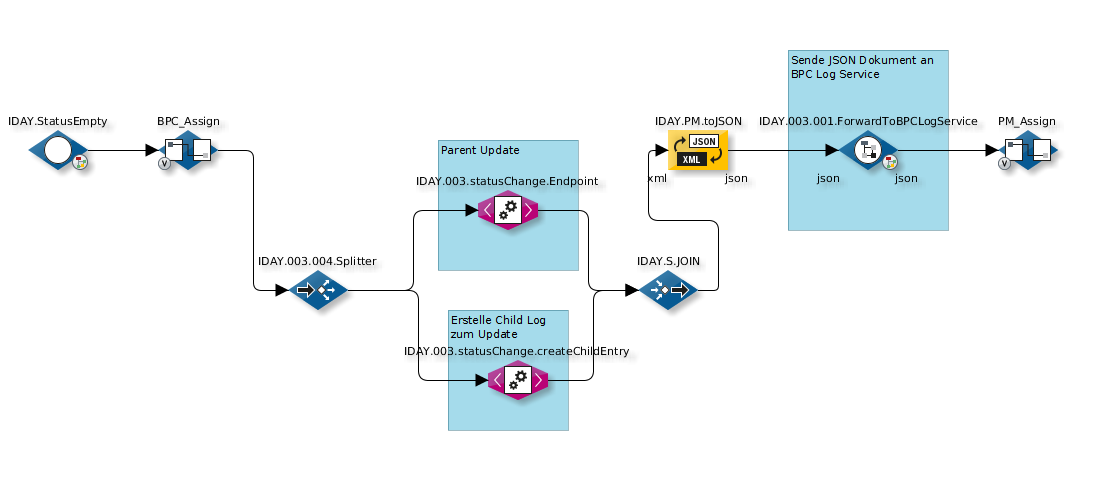
Values of the JSON fields
| Type | Value range |
|---|---|
Boolean |
true / false without quotation marks |
Date |
as ISO-8601 with quotation marks, e.g., "2017-05-17T15:28:23.181Z".
Create the field in the database as |
Numbers |
Value without quotation marks |
Binary |
Base64-encoded.
Create the field in the database as |
Text |
Value with quotation marks |
file-storage |
Files and references can be passed in various ways in a POST request; see File Storage in the Log Service.
Create the field in the database as a text column.
Additionally, text columns with the suffixes |
Configuration of ParentFields and ChildFields
Here, you can make fine-tuning adjustments to the data types (mapping for the OpenSearch indices), among other things.
Default for ParentFields
{
  "PROCESSID": {
    "type": "text",
    "skipOS": false,
    "skipDB": false
  },
  "LASTUPDATE": {
    "type"  : "timestamp",
    "skipOS": false,
    "skipDB": false
  },
  "externalReference" : {
    "type"  : "flat_object",
    "skipOS": false,
    "skipDB": false
  }
}
Default for ChildFields
{
  "CHILDID": {
    "type": "text",
    "skipOS": false,
    "skipDB": false
  }
}
Example
{
  "datei": {
    "type": "binary",
    "skipOS": true,
    "skipDB": false
  },
  "kommentar": {
    "type": "text"
  }
}
type
-
binary= are created in OpenSearch as 'binary' -
file-storage= are stored in OpenSearch and in the database as BPC file storage URIs (type: 'text'). Additionally, two fields are automatically created for the filename and the content type. These fields are named dynamically based on thefile-storagefield name with the suffixes_filenameor_contentType. -
text= are created in OpenSearch as 'raw' and 'lowercase', just as in replication. -
timestamp= are created in OpenSearch as ‘date’. If the placeholder 'SYSDATE' is used in the message to be logged instead of a UTC date, the log service sets the current timestamp instead. -
date:iso8601_millis= are created in OpenSearch as ‘date’ with the format ‘strict_date_optional_time\|\|epoch_millis’ -
integer= are stored in OpenSearch as ‘integer’ -
long= are stored in OpenSearch as ‘long’ -
float= are stored in OpenSearch as ‘float’ -
double= are stored in OpenSearch as ‘double’ -
boolean= are stored as ‘boolean’ in OpenSearch -
object= are stored as ‘object’ in OpenSearch -
flat_object= are stored as ‘flat_object’ in OpenSearch
By default, all fields are written to OpenSearch and to the database. If you do not want individual fields to be written, you can specify them here.
skipOS
true = the field is not written to OpenSearch
false = the field is written to OpenSearch (default)
skipDB
true = the field is not written to the database
false = the field is written to the database (default)
Field Name Convention
The data types for each field can be specified via the module instance setting fields (see below).
This is not strictly necessary for binary types and can also be achieved using the field name convention FIELDNAME_binary (with _binary as a suffix).
Background: In OpenSearch, we store binary data as Base64-encoded strings (so this is also how it must be formatted in the JSON being passed). However, as with replication, we want to store this data under the specific type 'attachment'. Since both are treated as strings by OpenSearch, we need to be aware of this and perform a special mapping.
Example: If we have a field named 'datei' and can assign names freely, this could become 'datei_binary,' and OpenSearch will store the data as 'attachment' or create the mapping for it.
Example Call
curl -H "X-ApiKey: 1f697af5-c147-3d94-c529-e06f3f15bb87" \
     -H "Content-Type: application/json" \
     -XPOST 'localhost:8181/cxf/bpc-logservice/log/of_test' \
     -d @logservice.json
Explanation:
| Option | Description |
|---|---|
|
The API key with the appropriate role or permission |
|
The Content-Type must be set to |
|
HTTP POST is required |
|
|
|
The JSON to be posted (see below) |
logservice.json (Create/update entry)
{
    "entries": [
        {
            "parent": {
                "processid": 40,
                "name": "hello world",
                "city": "Berlin",
                "lastupdate": "2017-05-17T15:28:23.181Z"
            },
            "children": [
                {
                    "processid": 40,
                    "childid": 1,
                    "ersteller": "Oliver",
                    "kommentar": "Bild und langer Text",
                    "datei": "iVBORw0KGgoAAAANSUhEUgAAAAIAAAACAQMAAABIeJ9nAAAABlBMVEUAAAD///+l2Z/dAAAADElEQVQIHWNwYGgAAAFEAMGoX3f9AAAAAElFTkSuQmCC",
                    "langertext": "Dieser Text ist aber ziemlich .................... lang. :-)",
                    "lastupdate": "2017-05-17T15:28:23.181Z"
                }
            ]
        }
    ]
}File Storage in the Log Service
The Log Service supports log entries with references to files in File Storage. There are several options:
-
Direct Reference: A reference (URI) to an existing file in file storage is saved.
-
Reference to a file in cloud storage: A reference to a file that already exists in cloud storage is passed. To do this, the log service stores the file metadata in file storage and saves a reference to it in the log entry.
-
Base64 Upload: The file is transmitted as a Base64-encoded string. The log service then stores this file in file storage and saves a reference to it in the log entry.
For all options, the information is passed in a field of type ` file-storage .
In the OpenSearch index and the database, it is always stored as a file storage reference.
Additionally, the filename and content type are stored in fields with the suffixes `_filename and _contentType.
|
When a log entry is deleted or overwritten, the referenced file is not automatically deleted from File Storage. If the file is to be removed, this must be done manually via the File Storage API. |
Enable File Storage Access
To log files that are transmitted as references in cloud storage or as Base64-encoded strings, file storage access must be enabled in the Logservice instance.
This is done using the following options:
-
filestorageUploadEnabled: must be set totrue -
filestorageBackendConnection: ID of the file storage backend Connection to be used -
filestorageBucket: Bucket or container in which files are stored. (If this value is empty, the default bucket defined in the file storage backend Connection is used.) -
filestorageReadRestriction: Read restriction for new files -
filestorageWriteRestriction: Write restriction for new files
|
The file storage backend Connection must be configured beforehand. Additionally, the defined bucket or container must exist in File Storage. |
File Storage References
File Storage References point to files managed by the File Storage Service and follow this schema:
bpc://backend-connection/FILE_STORAGE_BACKEND_CONNECTION_ID/FILE_STORAGE_ITEM_ID
Example of a POST request with a direct reference:
{
  "entries": [
    {
      "parent": {
        "id": "1",
        "file": "bpc://backend-connection/1752063970035/5919ea1ca9b5b8baee8b0cedc5e37c3c59c98fafefd71ed35d38bfc2aea288c7"
      }
    }
  ]
}
During logging, the filename and content type are automatically determined and do not need to be provided.
Cloud Storage Reference
If you want to reference a file from a cloud storage service for which no metadata yet exists in the File Storage Service, you can refer directly to the key in the cloud storage. To do this, File Storage access must first be enabled in the Log Service instance.
Then, using a POST request, the file’s ID or key can be passed in the ` filekey ` field as follows.
Optionally, the file name and content type can also be specified using the ` mediatype ` and ` filename ` fields, respectively.
{
  "entries": [
    {
      "parent": {
        "id": "1",
        "file": {
          "mediatype": "text/plain",
          "filename": "test.txt",
          "filekey": "cloud_storage_file_key.txt",
          "checkFile": true
        }
      }
    }
  ]
}
If no content type is provided, it is taken from the file metadata of the cloud storage provider. If no file name is provided, the file key is used.
The optional field checkFile (default: true) can be used to control whether the existence of the file in cloud storage should be checked immediately upon logging.
This is particularly helpful if the file is not uploaded until a later time.
In this case, set ` checkFile ` to ` false`.
However, the content type cannot then be derived from the cloud provider’s metadata and must be provided explicitly.
The Log Service stores only the reference (bpc://backend-connection/../..) in both the database table and the OpenSearch index.
Base64 Upload
If a file is to be uploaded directly, file storage access must first be enabled in the Log Service instance.
Then, the file content can be transferred as Base64-encoded text using a POST request as follows:
{
  "entries": [
    {
      "parent": {
        "id": "1",
        "file": {
          "mediatype": "text/plain",
          "filename": "test.txt",
          "content": "RGFzIGlzdCBlaW4gVGVzdC1UZXh0ZGF0ZWkK"
        }
      }
    }
  ]
}
In this case, the ` file-storage` field is a JSON object with the following fields:
-
content: the file as a Base64-encoded string (required field) -
mediatype: Media type of the file (optional, default:application/octet-stream) -
filename: File name (optional, default:file)
The log service stores only the reference (bpc://backend-connection/../..) in both the database table and the OpenSearch index.
