Data Management Installation and Update
Prerequisites
-
You have one of the following databases installed, including the driver:
See also Database-specific restrictions.
-
You have created an HTTP proxy connection to INUBIT in Backend Connections
-
You have downloaded the required workflow packages and repositories
-
You have downloaded the required BPC modules (
.vam,.jar)
Procedure
INUBIT:
-
Create the "VAM" user group in INUBIT
-
Assign the desired users to the group
-
-
Import the workflow and repository ZIP files into this user group
-
If necessary, install the database driver in INUBIT
-
Adjust the database parameters
-
INUBIT system diagram: Enter the database connection
-
INUBIT System Diagram: Check/change connection pooling settings in the DB connectors
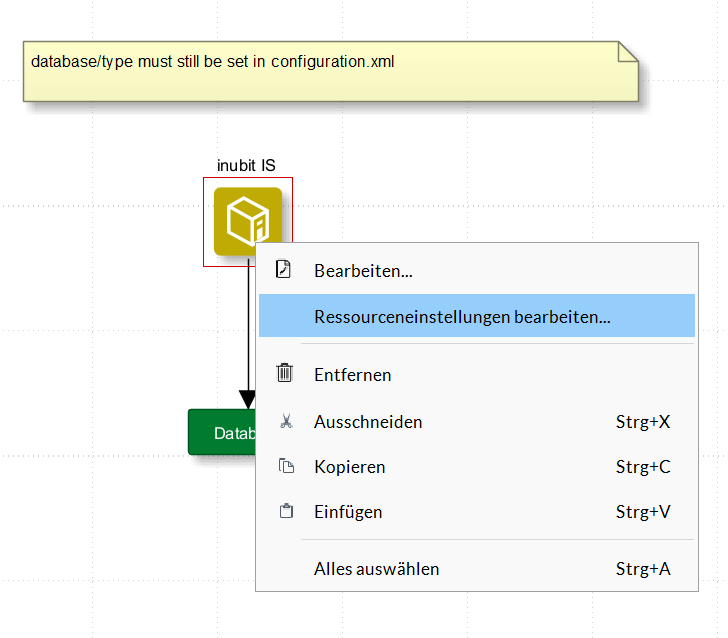
The default settings apply to an Oracle database. Adjust these accordingly if a different DBMS is used.
-
Enter the DB type ("oracle," "mssql," or "postgresql") in the VAM_api_configuration module
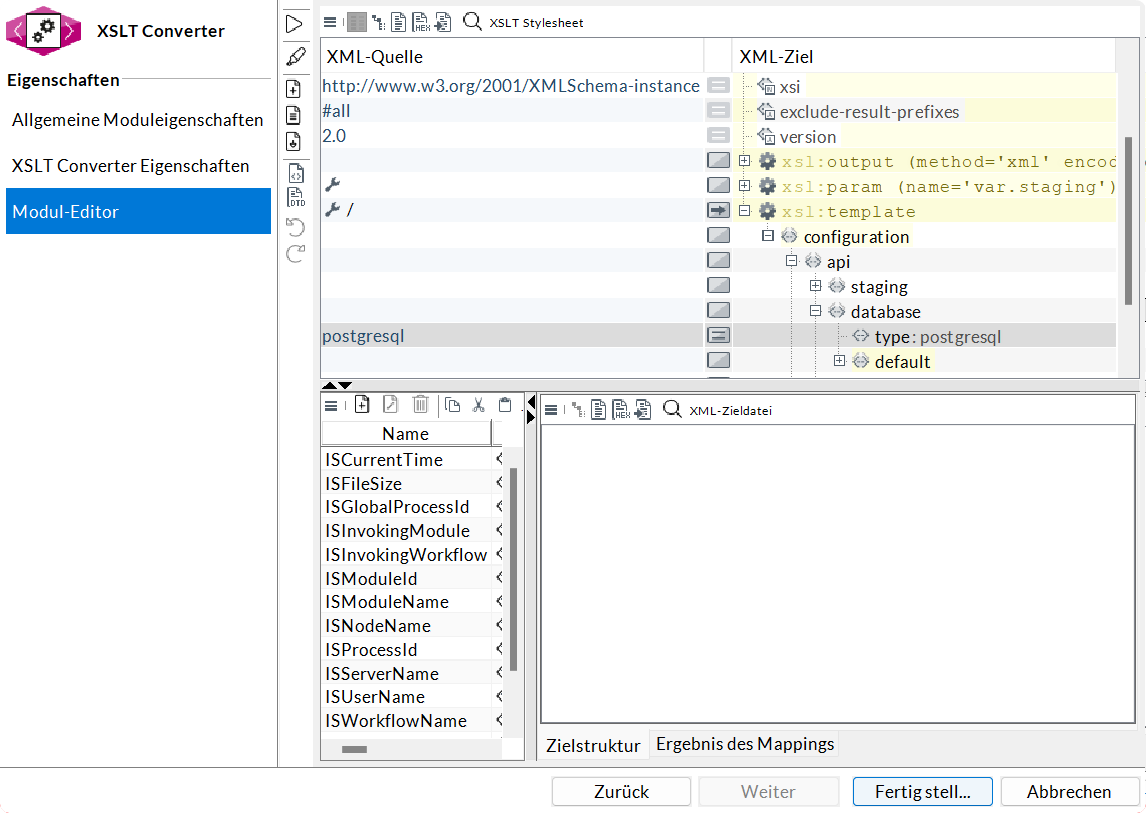
You can find the module in the VAM_api_main_newSession and VAM_api_attachUser workflows.
-
-
Connect to the database manually
For MSSQL, the name
T_INUBIT_ASSETMANAGEMENTmust be replaced with the actual schema name in the SQL files. -
Manually run the following scripts:
The scripts are located in the previously imported INUBIT repository, e.g.,
/Root/admin/VAM/backend/single-create-2.0.8-Oracle.sql.-
the most recent single-create script that matches the database
-
all single-upgrade scripts that match the database and have a higher version number
-
-
If errors occur, check the database permissions—this is often missing in Oracle
Grant execute on ctxsys.ctx_ddl. -
Activate workflows
BPC:
-
Deploy the BPC modules BPC-fe-vam.war and BPC-be-vam.jar to the BPC
-
If the BPC URL differs from the default, enter the custom BPC URL in the VAM_api_configuration module
-
Set up permissions in the BPC or BPC Identity Backend
Simplest setup for Data Management users:
-
for general read and write access: VAM-administrator role
-
for access to artifacts of the corresponding data pool (“Organization”): VAM_organization_NAME role—one per organization!
-
If necessary, create a user to whom these roles are assigned
-
-
-
Log out of and back into BPC using the user you just created,
Open the Data Management module once, if necessary -
If not already set up, configure an HTTP proxy to INUBIT, see Backend Connections
-
Create the Data Management module component
-
Enter the HTTP proxy
-
Enter the organization ID (freely selectable)
-
Save changes
The Data Management module is now accessible.
However, without templates, you can only create and delete test queries, for example, at this stage. -
INUBIT:
-
Generate a real password and enter it in the VAM_api_http_listener_protocol module
|
Use this password for automated access as well. |
Update
To update the entire Data Management application, both BPC and INUBIT must be updated.
BPC
-
Download the latest versions of Data Management (.vam, .jar)
-
Go to the BPC interface and open the Overview > Status tab in the administration area
-
Select the icon
-
In the pop-up window, upload the
.vamand.jarfiles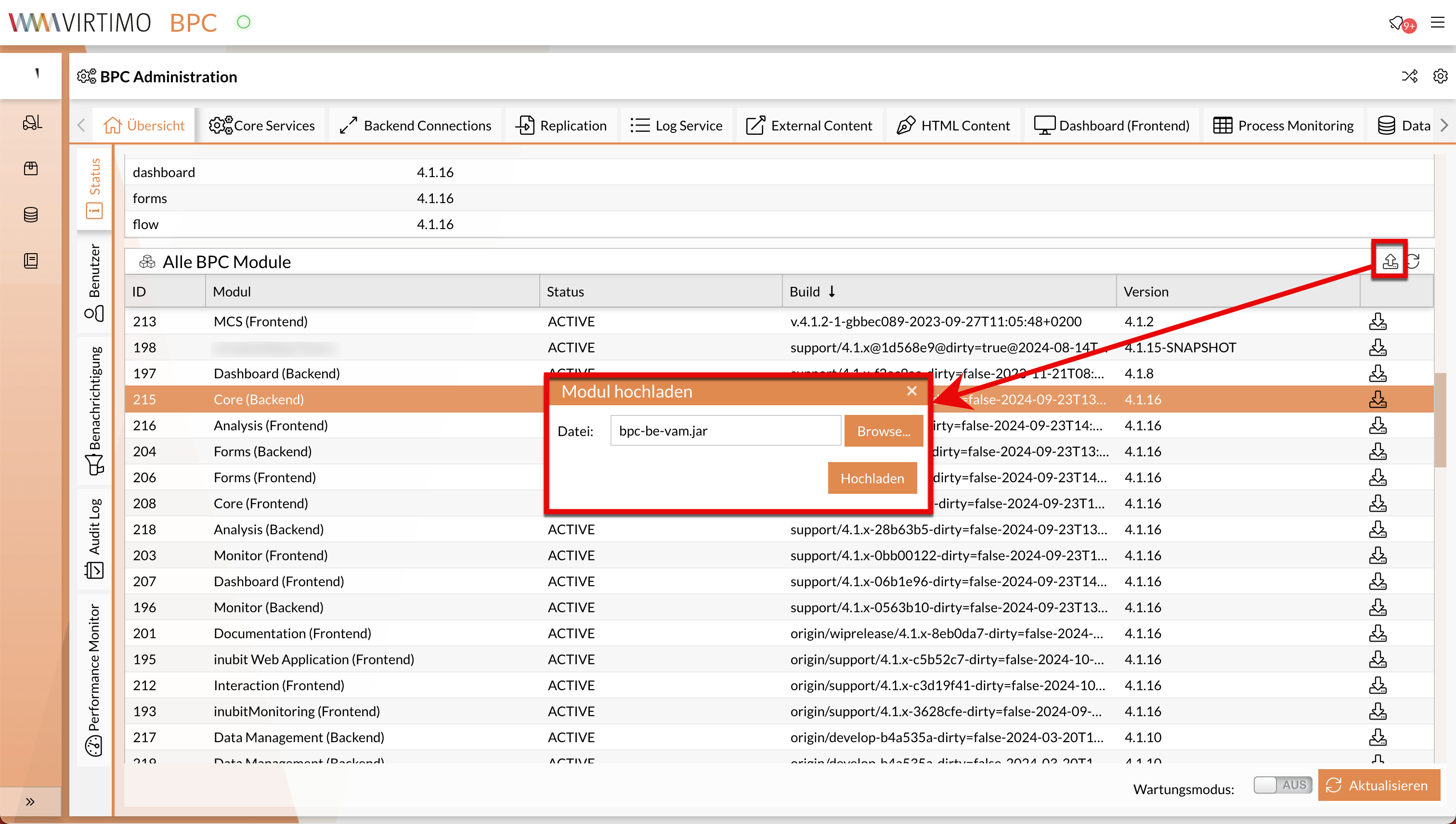
INUBIT
-
Download the latest versions of the zipfiles
VAM.diagrams_ohne_SystemdiagrammandVAM.repository -
In INUBIT, switch to the VAM user group
-
Open the VAM user group settings
-
VAM.diagrams_ohne_Systemdiagramm.XXXX.zipImport to replace the outdated files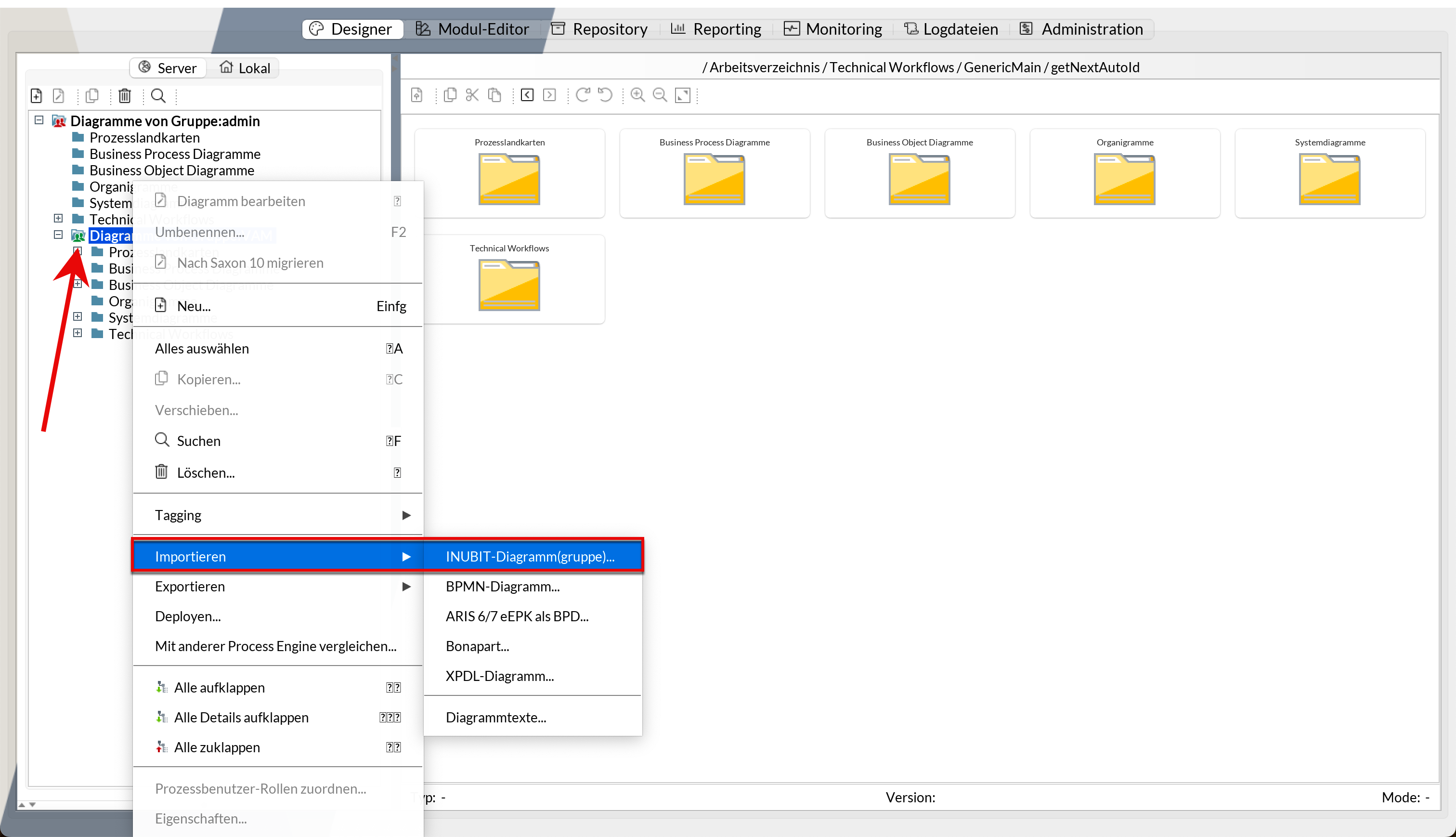
-
Switch from the Designer tab to the Repository tab.
-
Click on the VAM user group and import the latest
VAM.repository.XXXX.zipfile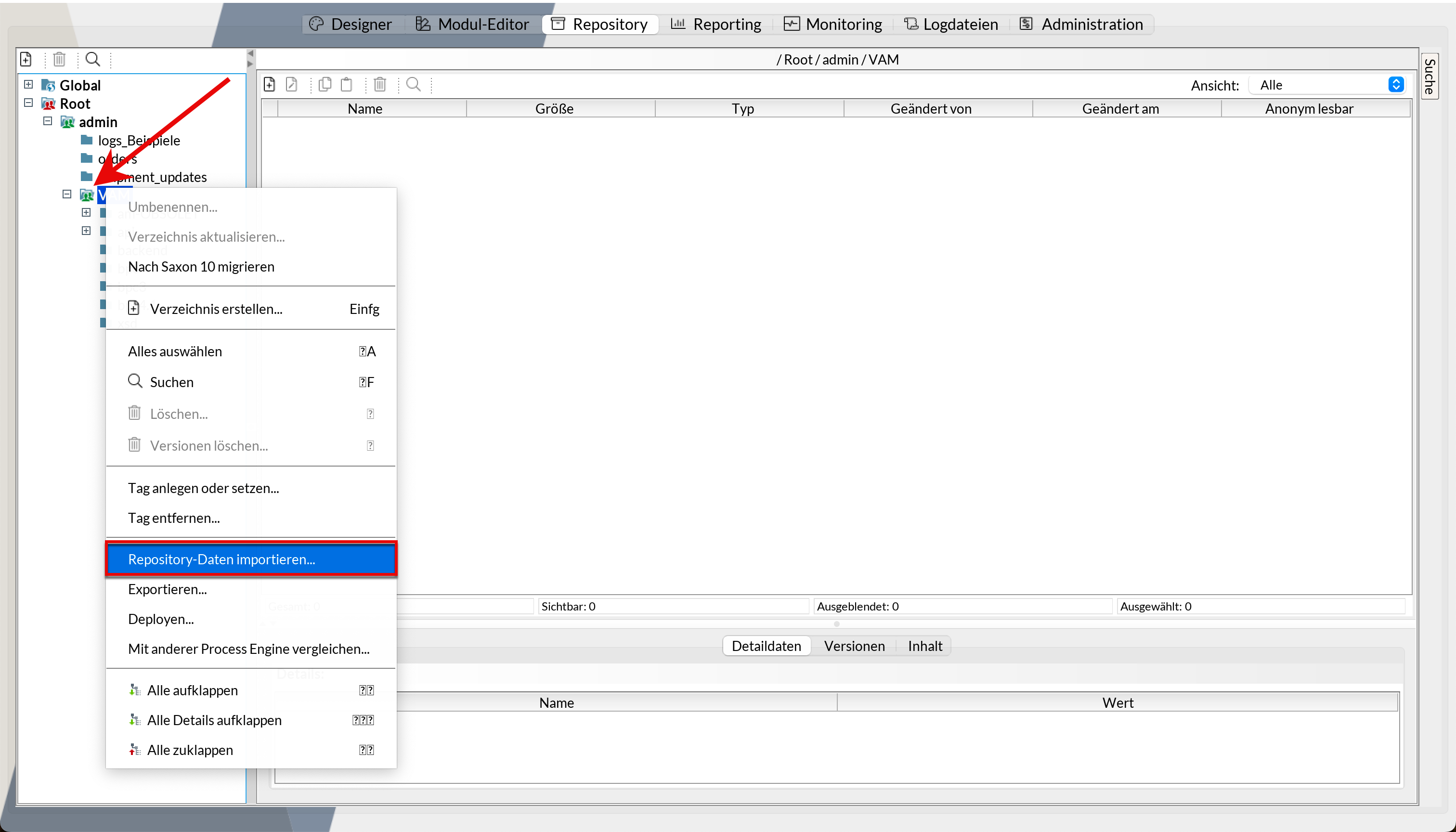
-
If a new script has been released, manually execute the latest database script in your DBMS
-
In the Designer tab, activate the imported workflows
Database-specific restrictions
Oracle
-
Standard field "Description":
Description can be no longer than 4,000 characters -
Contextual search by username (“created by” and “modified by” / “contains”):
Search does not work in some Oracle versions due to an optimizer bug
MSSQL
-
Contextual search in standard fields:
Only searches for word prefixes are possible -
Character set encoding:
Use of non-Latin-1 characters in indexed fields (e.g., user-defined ID, user ID) is problematic;
the same applies if database defaults are poor; keys are case-sensitive or contain accents -
Key length:
Keys for indexes may be up to 931 characters long
(currently no known use case where this length is exceeded)
